Both are extraordinary. Only one fits your trip. Here’s how to pick in 30 seconds — then the details, if you want them.
The call
Choose teamLab Planets if you want to feel the art — you’ll be barefoot, wading through knee-deep water, lying on your back under projected flowers. It’s shorter (1.5–2 hours), it’s a single fixed path, and it’s the better first-timer’s teamLab.
Choose teamLab Borderless if you want to get lost in the art — no map, no route, 75-plus works that spill into each other and move between rooms. It’s longer (2–3 hours), more cerebral, and better if you’re the type who reads every museum label.
Doing both? Genuinely fine — they share a name and a studio but almost nothing else. Just don’t do them on the same day. Two sets of infinite mirror rooms in one afternoon is more than a brain wants.
The comparison, side by side
| teamLab Planets | teamLab Borderless | |
|---|---|---|
| Where | Toyosu — 1 min from Shin-Toyosu Stn (Yurikamome) | Azabudai Hills — 2 min from Kamiyacho Stn (Hibiya Line) |
| Adult ticket | from ¥3,600 (dynamic, to ~¥4,800) | ¥3,600–5,600 (dynamic) |
| Kids 4–12 | ¥1,500 | ¥1,500 and up |
| Time needed | 1.5–2 hours | 2–3 hours |
| Route | One-way, linear | No map, wander freely |
| Water | Yes — barefoot, knee-deep | None |
| Hours | 8:00–22:00 | ~10:00–21:00, closed 1st & 3rd Tue |
| Running until | End of 2027 (confirmed) | Permanent, no end date |
Both use dynamic pricing — the same ticket costs more on a Saturday afternoon than a Tuesday morning. Check the official sites for your exact date.
Get tickets
Both museums sell timed slots that disappear weeks ahead. Klook is an authorised seller for both and shows the remaining slots in one place.
Or book direct: Planets official · Borderless official
What Planets actually feels like
You take off your shoes and socks at the entrance and don’t put them back on for two hours. That’s the whole design principle: the art meets your skin.
You wade through a dark room where projected koi swim around your legs and burst into flowers when they touch you. You lie down on a mirrored floor under a canopy of thousands of hanging orchids that descends toward your face. You climb through an inflatable landscape that behaves like a bouncy castle designed by someone who has read too much philosophy.
Practically: wear or bring shorts. The water goes above the knee in places, and while there are free rental shorts (XS to 6L) and towels, you don’t want to spend your visit in a queue for them. Wet clothes will block you from the next room until you change. If you’re wearing a skirt, note that several floors are mirrors — the same free shorts solve it.
It’s the more photogenic of the two in the obvious Instagram sense — the water-and-light rooms are absurd in the best way. It’s also the more physical: 2.5 million people came in 2025, and the crowd moves as one along the fixed path, which is both efficient and, at peak times, a bit like a very beautiful conveyor belt.
What Borderless actually feels like
There is no map. That is not an oversight — the works wander out of their rooms, walk down corridors, and interrupt each other. You are meant to be slightly lost.
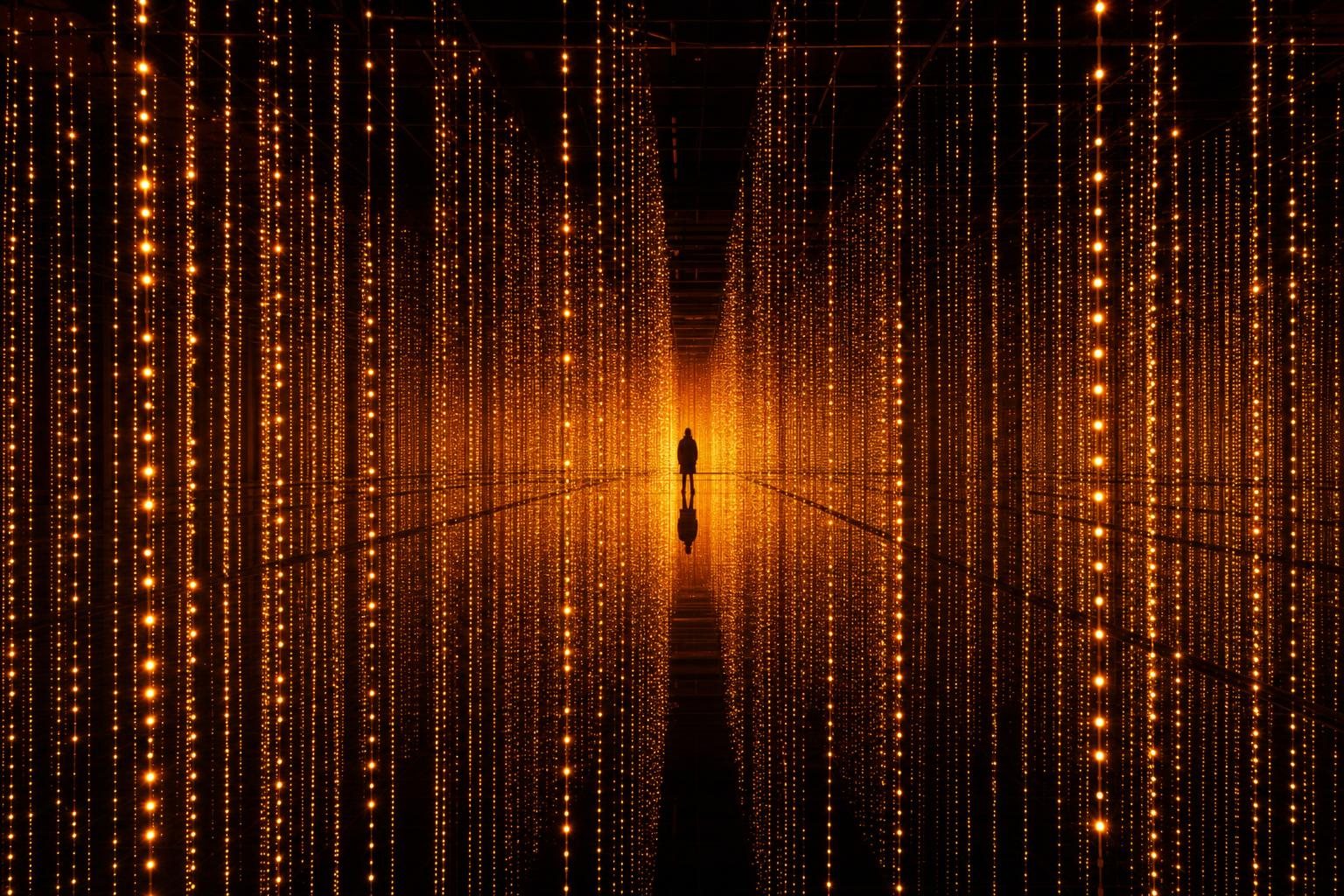
The upside: genuine discovery, and rooms you stumble into that you’d never have found on a route. The downside, and it’s a real one, is that the most famous work — the Infinite Crystal Universe, all suspended LED strings — can be hard to locate and can carry a queue of an hour or more at peak times. Visitors say this consistently.
Through October 8, 2026, Borderless is running On the Asymmetry of the Universe in the reopened Light Sculpture – Flow room, with new series that haven’t been shown before. If you’re deciding between the two and you like a bit of novelty, that tips it.
No water here, so no shorts required — but the mirrored floors are extensive. Trousers are the low-stress choice.
Which one for whom
- Young kids → Planets, with a caveat. The linear path means you can’t lose them, and the Athletics Forest is a genuine playground. But it’s dark, the floors are wet, and there’s a minimum height requirement for the water works (small children get carried). Under-13s need an adult.
- Teenagers → Either. Borderless if they’re the moody-artistic kind, Planets if they want the photos.
- Rainy day → Both are fully indoor. Slight edge to Borderless: Planets’ outdoor queue area has limited shelter, and standing in the rain before taking your shoes off is a poor start.
- Limited time in Tokyo → Planets. Two hours, done, and Toyosu Market is next door for lunch.
- You’ve been to a teamLab exhibition abroad → Borderless. The permanent Tokyo works go further than the travelling shows.
- Mobility concerns → Planets involves uneven, wet, sloped surfaces and barefoot walking. Borderless is easier underfoot but involves more total walking and nowhere obvious to sit.
Booking: the part people get wrong
Both sell timed entry slots, released roughly two to three months ahead. Weekend and holiday slots can vanish within days of release during cherry blossom season, Golden Week, Obon and New Year.
- Weekday visit: book about a month ahead
- Weekend or peak season: book 2–3 months ahead
- Same-day tickets: don’t plan on it. Planets sells no tickets on site at all. Borderless has a booth, but treat any stock as a lucky accident.
- If your preferred time is gone: try the very first slot of the day or a late evening one. Both are less contested and — this matters — noticeably less crowded inside.
Only the official sites and Klook are authorised sellers. Anything else is a reseller adding a margin, at best.
FAQ
Are they worth ¥3,600–5,600?
For a first visit, most people say yes — including people who went in sceptical about “digital art.” For a second visit to the same venue, opinions cool considerably. If you have one teamLab in you, make it count.
Can I do both in one day?
Physically yes — they’re about 40 minutes apart by train. But it’s a lot of dark rooms and infinite mirrors for one nervous system, and you’ll stop noticing things. Split them across two days if you can.
How crowded is it really?
Planets had 2.5 million visitors in 2025, Borderless 1.7 million. Assume crowds at any midday weekend slot. The first slot of the day is the single most effective fix.
Is the photography as good as the photos suggest?
Mostly. Phones handle these rooms surprisingly well, because the art is the light source. Bring a lens cloth for Planets — humidity and spray are real.
Will Planets close?
It’s confirmed to run through the end of 2027. It has been extended several times from an original 2020 closing date, so treat closing announcements with some scepticism — but don’t count on another reprieve either.
The bottom line
Planets for the body, Borderless for the wander. If someone forced us to pick one for a first-time visitor with a packed Tokyo itinerary: Planets — it’s shorter, it’s easier to fit in, and walking barefoot through a river of digital koi is the thing you’ll actually describe to people back home.
Prices and hours as of August 2026, and both venues use dynamic pricing — confirm on the official site for your date. Corrections via the contact page. Some links here are paid affiliate links.
Book before you forget
Weekend slots at both museums vanish weeks ahead. Klook is an authorised seller for both and shows what is left in one place.
Leave a Reply