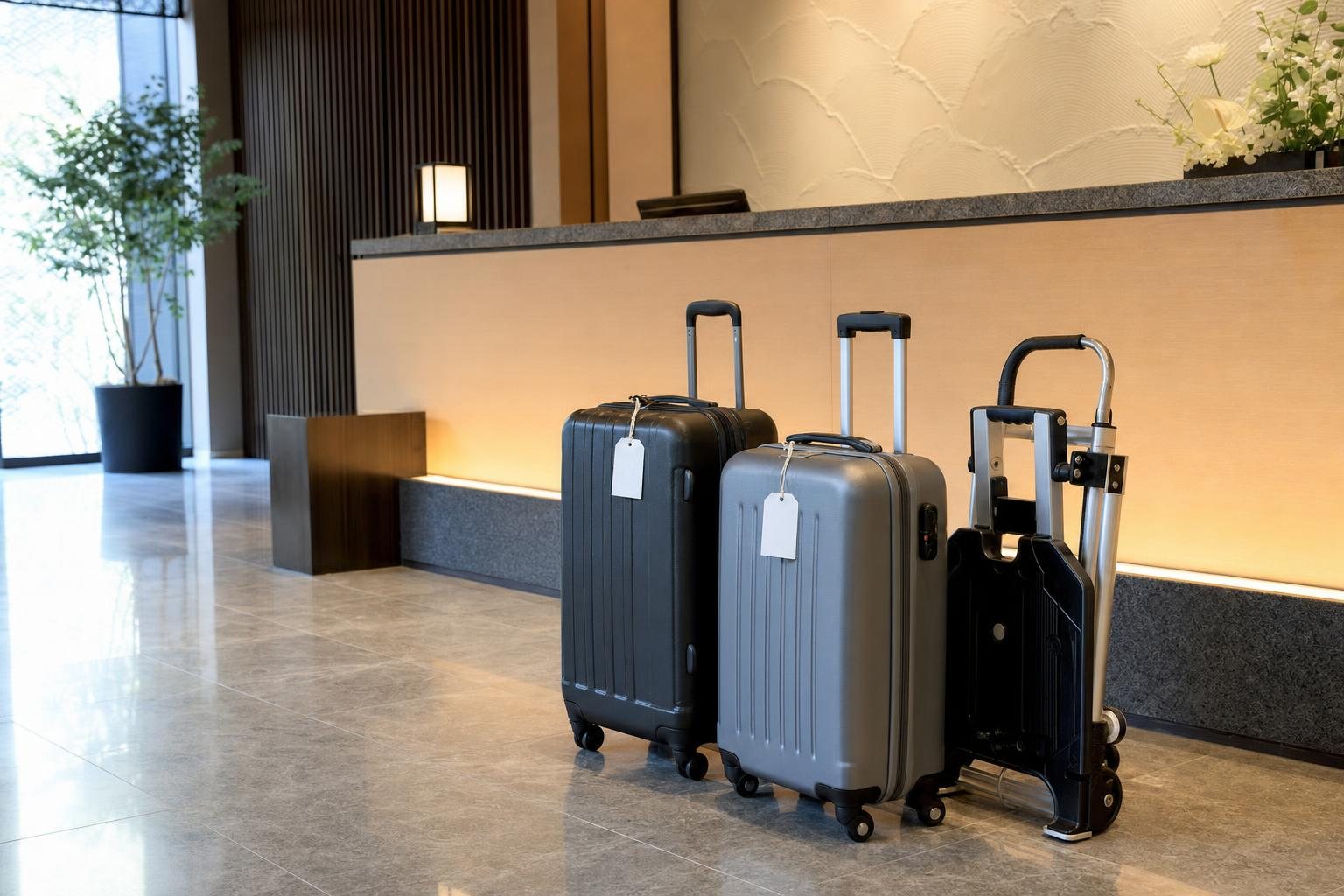
The short answer: hand your suitcase to your hotel’s front desk tonight, and it will be waiting at your next hotel tomorrow evening — for about ¥3,160 ($21) per big bag. This is the single most underrated travel system in Japan, locals use it constantly, and most visitors discover it on their last day. Let’s fix that.
Why this beats dragging your bag onto the Shinkansen
Japanese trains are luggage-hostile in a very polite way: oversized-baggage seats on the Tokaido Shinkansen must be reserved, station staircases appear out of nowhere, and rush-hour trains have no space for a 28-inch suitcase and your dignity. Meanwhile, the delivery network (takkyubin — you’ll see the Yamato black cat logo everywhere) moves boxes overnight with near-mythical reliability. Locals send suitcases ahead to airports, hotels, even ski resorts. The Local Test doesn’t get clearer than this.
What it costs (as of Aug 2026)
Prices below are Yamato’s standard Tokyo→Kyoto rates — the route most of you will use. Size = height + width + depth in cm.
| Size | Fits | Price | approx USD |
|---|---|---|---|
| 100 | Carry-on suitcase | ¥1,650 | ~$11 |
| 120 | Medium suitcase | ¥2,170 | ~$14.50 |
| 140 | Large suitcase | ¥2,780 | ~$18.50 |
| 160 | Big check-in suitcase | ¥3,160 | ~$21 |
The rule nobody tells you: an unboxed suitcase is charged as size 160 even if it technically measures more — up to 200cm/30kg total. In practice, ¥3,160 is the ceiling for almost any suitcase you’d fly with. (Drop it at a Yamato counter or convenience store yourself and it’s ¥100 less, but the hotel desk is the easy way.)
How to actually do it, step by step
- Ask your front desk: “Takkyubin to my next hotel, please.” Every hotel in Japan knows this drill
- Fill the slip with the next hotel’s name, address, phone, your name as booked, and your check-in date — hotels hold bags for arriving guests as a matter of routine
- Pay (cash is safest; many desks take cards) and keep the tracking slip
- Pack a one-night daypack: your bag leaves tonight and arrives tomorrow evening, so keep a change of clothes, chargers, and valuables with you
Nobody tells you this: you can do it from a convenience store
Every English guide sends you to the hotel front desk or a courier office. Both work. But the thing residents actually do, and that visitors almost never hear about, is walk into a 7-Eleven or FamilyMart and hand the bag over the counter.
That is the whole trick. Those two chains are Yamato agents. The counter that sold you an onigiri at 2am will also send your suitcase to Kyoto.
Why it matters more than it sounds:
- They are open when nothing else is. Hotel desks close, courier offices shut at 19:00. A konbini does not. If you realise at 11pm that tomorrow involves three trains with a large case, you can fix it tonight
- There is one on the way. You do not need to find the Yamato office. You need to find the shop you were already walking past
- You can send a bag to the airport from one. Airport takkyubin is accepted at convenience stores, so your case can go to Narita or Haneda while you spend the last day unencumbered
The limits, which are real
- 160cm total (all three sides added) at FamilyMart. Some 7-Elevens go higher, but not all take over 180cm or 30kg. A standard large suitcase is fine; a bike box is not
- 30kg maximum
- Outbound only. You can send from a convenience store. You cannot collect there — that is a common and expensive misunderstanding
- No chilled deliveries from konbini. If you bought something that needs Cool Takkyubin, you need a proper Yamato counter
- Lawson is a different carrier, so the slip and the prices differ. Use 7-Eleven or FamilyMart if you want the Yamato service described here
Doing it without Japanese
The slip is in Japanese and the staff member may not speak English, but this is a very well-worn transaction and it survives having no shared language. What makes it work:
- Have the destination address in Japanese on your phone. This is the one thing that actually matters. Screenshot it from the hotel’s Japanese-language site, or ask your current hotel to write it out before you check out. An address in romaji will slow everything down
- Write your own name exactly as the booking, plus your check-in date. Hotels routinely hold bags for guests arriving later
- Point at the bag, say “takkyubin”. That word does all the work
- Pay at the register and keep the slip. It has the tracking number
If the queue behind you is growing and the form is defeating you, the hotel front desk is still the easier option in daylight hours. The konbini is the answer for the other sixteen hours of the day.
Timing rules that matter
- Next-day is the standard, almost everywhere in Japan (Hokkaido, Okinawa and some regions take 2 days)
- There is no same-day Tokyo→Kyoto. Same-day exists only within a city (Kyoto same-city: ¥2,860) and from airports
- Airport shortcut: landing at Haneda? Drop bags at the Yamato counter before 11:00 and they reach central-Tokyo hotels the same evening (roughly ¥4,600 all-in for a big bag, including the airport counter fee). Narita’s cutoff is ~10:30. Landing later? It arrives next day — still better than hauling it through rush hour
- Don’t send: passports, cash, valuables, or loose lithium batteries (power banks stay with you — same rule as flying)
When NOT to bother
Skip forwarding if you’re only moving between two hotels in the same city (just taxi it), if your bag is a carry-on you can genuinely carry, or if you check out tomorrow morning and land at your next city by noon — the bag won’t beat you there. This system shines on the classic multi-city route: Tokyo → Hakone/Kyoto → Osaka, where each transfer day becomes a free sightseeing day.
FAQ
Will the next hotel accept my bag before I check in?
Yes — standard practice nationwide. Write your booking name and check-in date on the slip and it’ll be in your room or behind the desk when you arrive.
When do I hand it over for next-day delivery?
The evening before, or by early morning pickup (ask the desk for their cutoff — usually before ~9:00).
Does my suitcase need a box?
No. Suitcases travel naked with a tag. That’s normal here.
Can I send bags to the airport for my flight home?
Yes — allow an extra day, and Yamato/JAL ABC counters at the terminal hold them for pickup. Locals do this routinely.
Is it safe?
This is Japan’s everyday logistics backbone, with liability coverage up to ¥300,000 per item. Losing a bag is national-news rare.
The bottom line
¥3,160 to turn a sweaty luggage-hauling day into a hands-free one is the best money-for-misery trade in Japanese travel. Book nothing, download nothing — just talk to your front desk tonight.
Station-specific storage: Tokyo, Shinjuku, Shibuya, Asakusa & Ueno.
If the bag just needs to disappear for the day rather than travel somewhere, that’s storage, not forwarding — we covered lockers, counters and booked storage in Tokyo separately.
Rates are Yamato’s standard cash rates as of August 2026 (last revised Oct 2025) and vary slightly by route; verify at the desk. Corrections welcome via the contact page.
Leave a Reply