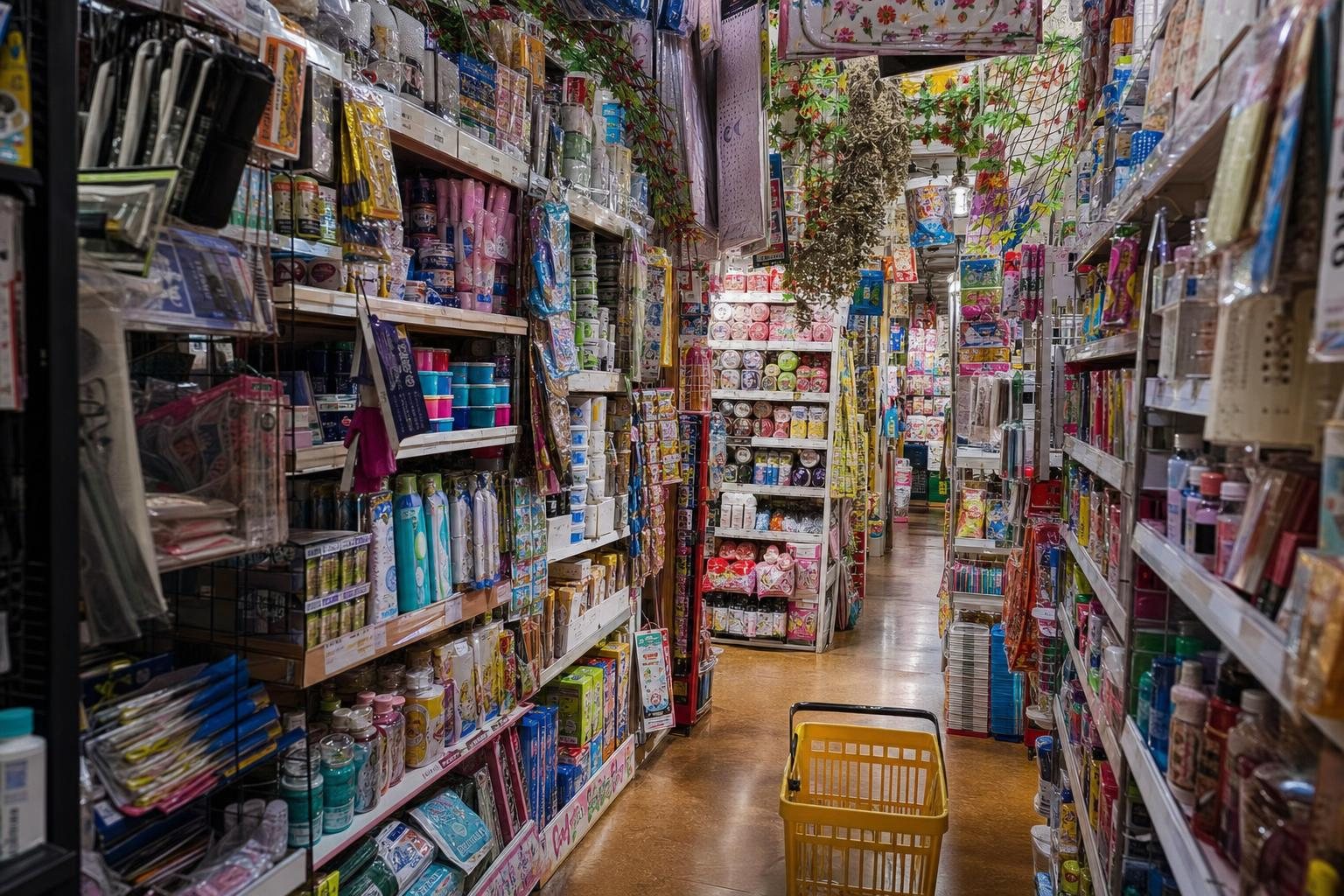
Somebody built that. A person decided the wall of animal-face masks should go there, at that price, in that order. And that person is quite possibly a part-timer who has never asked a manager’s permission for anything.
The call
Get the coupon before you go in. Free, thirty seconds, worth 5% over ¥10,000 or 7% over ¥30,000 on top of the tax exemption. No signup.
Buy snacks, kitchen tools, character goods, cosmetics. Skip electronics, groceries, clothes, whisky and — people really do this — a suitcase.
Go after midnight if your body clock is still somewhere over the Pacific. Most city branches never close, and at 1am the place is yours.
Do this first
Show it on your phone at the register: 5% off over ¥10,000, 7% over ¥30,000, on top of tax-free. Around 600 stores, no signup, no app.
The thing to understand about Donki
Every guide describes Don Quijote as chaotic. Almost none explain why, and the why is the most interesting fact about Japanese retail.
At Donki, the person who decides what a shelf sells, what it costs and how it looks is the staff member who works that section — including the part-timers, who the company calls Mates. They own a category: home appliances, snacks, cosmetics. They do the buying. They set the prices. They build the display. Some of them negotiate directly with manufacturers.
There is no planogram handed down from head office telling them where the shampoo goes. A Nikkei Business piece on the company was headlined, flatly, “there is no manual in the stores.” Another described the internal rule that a display may not repeat last year’s. Copying yourself is the one thing you are not allowed to do.
So when you stand in front of a hand-lettered sign in three colours, mounted above a pyramid of instant noodles and a bin of novelty socks, you are not looking at corporate strategy. You are looking at one person’s opinion about what will sell in this neighbourhood this week — written by hand, because they wrote it.
The founder, Takao Yasuda, built the company on this. It now turns over more than ¥2 trillion a year and is Japan’s fourth-largest retailer. The chaos is not a failure of discipline. It is the product.
Which is also why every branch is different, and why locals have a favourite one. You are not shopping in a chain. You are shopping in someone’s shop, and the someone changes when you cross town.
Practical consequences of a store built like this
You cannot scan it from the door. That is deliberate — the technique is called atsuryoku chinretsu, compression display. You have to walk it, and while walking it you find the thing you didn’t know existed. It works on everyone, including us.
Don’t bring a suitcase in. The aisles fit one person, not a person and a large case, and the queue behind you will be far too polite to mention it. Park the bag first.
The tax-free counter may be nowhere near the tills — 7F at the Shibuya flagship. Budget for the lift.
Ask someone. This is the part visitors never try. The staff member in that aisle chose the stock in that aisle. They know exactly which of the four sunscreens moves fastest and why. It is the best product advice available in Tokyo and it is free.
The song
You will hear it four seconds after entering. “Miracle Shopping,” written and sung in 1999 by a woman who worked for the company, playing on loop in every branch since.
It has become genuinely iconic — enough that in 2024, Bruno Mars made a commercial for the chain. Four bars, twenty-five years, one former employee’s song. Japanese retail does not usually produce folk music.
The coupon, and the arithmetic nobody does
People assume 10% tax-free plus 7% coupon is 17% off. It isn’t. Tax-free doesn’t take 10% off the shelf price — it removes the tax already inside it, about 9.1% — and the coupon then applies to what’s left.
| Spend (pre-tax) | Coupon | Real total saving |
|---|---|---|
| ¥10,000–29,999 | 5% | about 13.6% |
| ¥30,000+ | 7% | about 15.5% |
Rules, each of which has ruined somebody’s evening:
- A screenshot won’t work. The page must be live. Donki provides free in-store Wi-Fi, which tells you how often this happens
- Show it before scanning starts. Afterwards it’s void
- One use. It dies when you tap “Used”
- Excluded: alcohol, tobacco, prepaid cards, games consoles, single items over ¥100,000 — and excluded items don’t count toward the threshold. ¥9,000 of snacks plus a ¥4,000 bottle of whisky earns you nothing
- No stacking with a majica card or other in-store offers
Tax-free separately needs ¥5,000 before tax and your physical passport. Not a photo of it.
And if you’re here after 1 November 2026: the tax comes back at the airport now, not at the till. The coupon is unaffected. What changes.
What’s worth buying
The snack wall. Regional and limited-run KitKats — wasabi, matcha, sake, prefecture editions that exist for six weeks and then never again. ¥300 a small pack, ¥900–1,000 a gift box. The one souvenir that has never disappointed anybody’s colleagues.
Kitchen tools. Onigiri moulds, sesame grinders, a device whose sole function is to make a boiled egg square. Cheap, genuinely used at home afterwards, and nobody plans for it.
Character goods and gacha. Budget forty minutes you hadn’t allocated.
Cosmetics — big range, competitive, but not automatically cheapest. Price-check against Sundrug or Matsumoto Kiyoshi. What’s worth the suitcase space.
Second-hand luxury at some branches, notably Shinjuku Kabukicho — used Vuitton, Chanel, Gucci, authenticated through the industry anti-counterfeiting association. Two catches: single items over ¥100,000 lose the coupon, and your own country’s duty can erase the whole saving.
What to buy elsewhere
| Not here | Here instead |
|---|---|
| Electronics | Yodobashi or Bic Camera — cheaper, better tax-free desks |
| Fresh food and daily groceries | A supermarket, or a convenience store |
| Japanese whisky | Compare first — markups on Yamazaki and Hibiki are widely reported, and alcohol is coupon-excluded anyway |
| Basic clothing | Uniqlo or GU |
| A suitcase | It will get you home and no further |
MEGA or standard
MEGA branches add a full supermarket floor and several merchandise floors. For a souvenir haul, go MEGA. More floors, more of everything, and a properly staffed tax-free counter.
FAQ
Which branch?
MEGA Shibuya for range. Shinjuku Kabukicho for second-hand luxury. There’s one in Asakusa’s Ekimise building since June 2026, useful if you’re already at Senso-ji.
Worth the coupon under ¥10,000?
It does nothing below that. Just do tax-free above ¥5,000.
Coupon and tax-free together?
Yes, same counter, same passport. Coupon first.
Cheaper than a drugstore for medicine?
Not reliably. What’s worth buying, and what’s illegal to take home.
The bottom line
Coupon open, suitcase elsewhere, arrive late, buy snacks and kitchen tools and one item you cannot justify.
And when you get to a display that stops you — the one built like a shrine to a single flavour of Pocky — remember that somebody’s shift went into it, and they were told not to do what they did last year.
Before you go in
One tap, no signup, shown at the register. Void if you present it after payment starts, so have it open before you queue.
Coupon terms, store details and hours as of September 2026 and subject to change — confirm on the coupon page before you shop. Corrections via the contact page. Some links here are paid affiliate links.
Leave a Reply