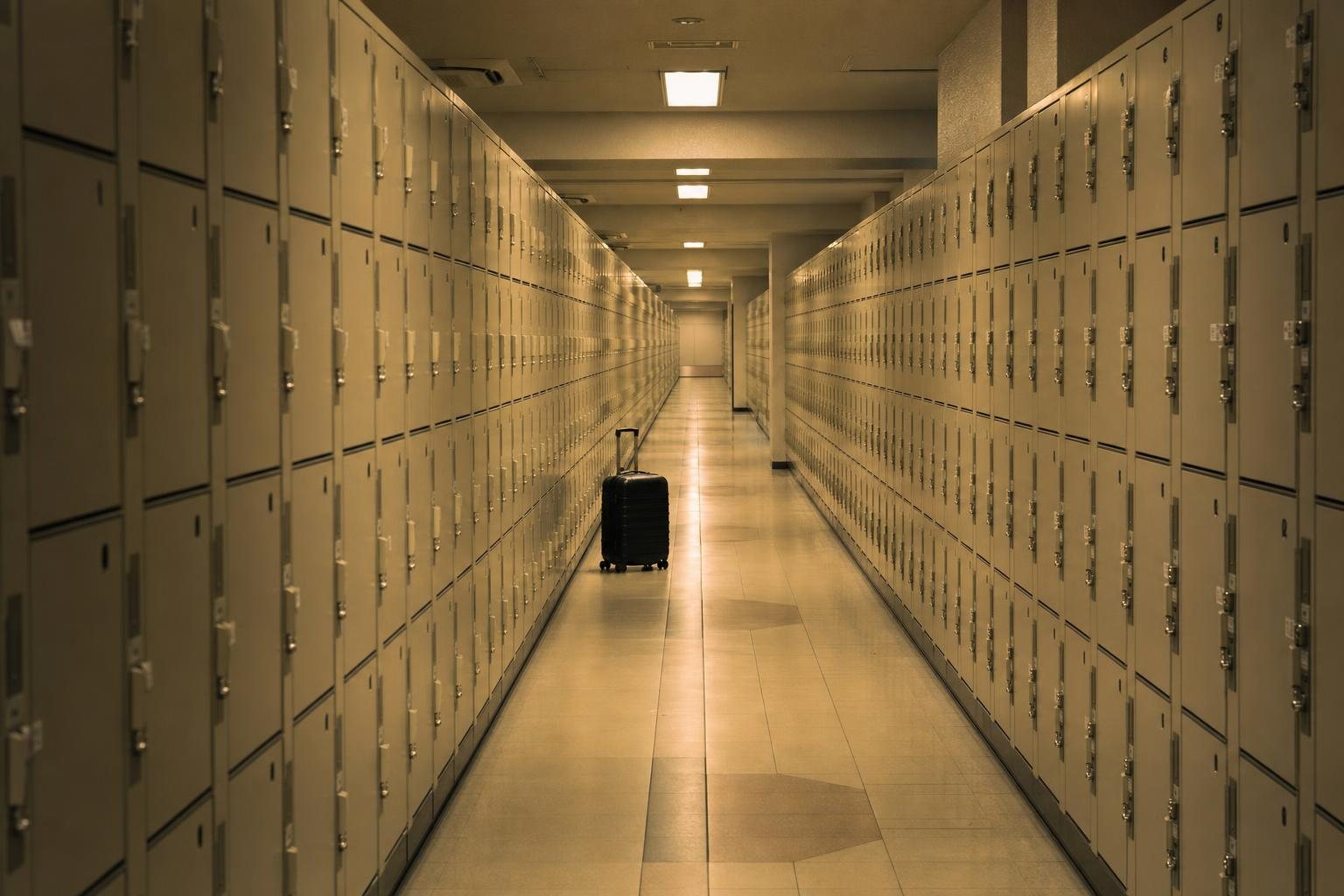
Tokyo Station has over a hundred locker banks and roughly 5,000 lockers, and people still walk out unable to find one. That’s a navigation problem, not a supply problem. Here’s the map.
The call
If you need a large locker, go straight to the B1 GRANSTA bank (inside the gates) — it has around 900 lockers including 40 large ones, the biggest single cluster in the station. If that’s full, go deeper: the B4 Sobu/Yokosuka platform level and the Keiyo Line passage stay free longest precisely because they’re a long walk.
If you’re outside the ticket gates without a ticket, your options shrink a lot — head for the Yaesu North Exit bank or the Marunouchi North free passage.
Reserve, rather than gamble
At Tokyo Station a reserved spot is worth the small premium: you stop walking, and the bag is guaranteed a place. Flat rate per bag per day, any size, insured.
If your suitcase is 30 inches or you’re carrying skis, don’t hunt for a locker at all. Use a staffed counter.
The one thing to check first: inside or outside the gates
Tokyo Station’s locker banks are split between the paid area (inside the ticket gates) and the free area. This is the detail that ruins people’s afternoons: the biggest and best banks are inside, and if you’ve already exited, or you arrived by subway, you can’t reach them without buying a ticket.
So decide before you tap out.
The banks worth knowing
Inside the gates
| Bank | Roughly | Notes |
|---|---|---|
| B1 GRANSTA | 728 S / 152 M / 40 L | The big one. Follow GRANSTA mall signage after any underground central or north gate |
| B4 Sobu / Yokosuka platform level | Several hundred, many large | Deep underground, long walk, best large-locker odds |
| Keiyo Line passage | 78 S / 33 M | JR East’s own guide calls it “comparatively uncrowded.” Past the third moving walkway, on the left |
| Marunouchi central gate | 40 S / 19 M | Most visible, therefore first to fill |
| Marunouchi underground central/north | 91 S / 37 M | B1, small and medium only |
Outside the gates
| Bank | Roughly | Notes |
|---|---|---|
| Yaesu North Exit | 80 S / 51 M | Nearest to the Shinkansen transfer gates |
| Marunouchi North free passage | 39 S / 26 M | Use this if you haven’t tapped in yet |
| Yaesu bus terminal (new) | Reported ~283, incl. ski-size | Opened March 2026 under the Yaesu bus terminal. Time-based pricing, not daily |
Prices
Standard JR East sizes: SS ¥300, S ¥500, M ¥700–800, L ¥900–1,000 per day. During peak travel seasons the app-linked “Multiecube” lockers add a ¥100–200 surcharge on medium and large.
Newer machines take Suica, PASMO, PayPay, WeChat Pay, Alipay and contactless cards. Some older underground units are still ¥100 coins only, so keep a few.
You can reserve a locker in advance through Multiecube (multiecube.com) — up to a month ahead, for an extra ¥500 per box. For a tight connection with a big case, that ¥500 buys certainty, which is the whole problem at this station.
Will a 28-inch suitcase fit?
A large locker measures roughly 35cm wide × 65cm deep × 87cm tall (355 × 645 × 868mm is the common spec). A typical 28-inch case is about 75cm tall and 48cm wide, so it fits — but only if you turn it and the wheelbase isn’t unusually wide. Hardside spinners are the ones that don’t.
A 30-inch case usually will not fit any standard locker here. Nor will skis, golf bags, or a bike box. That’s what the counters are for.
Staffed counters (when lockers won’t do)
- JR East Travel Service Center — Marunouchi North Exit, 1F, outside the gates. 8:30–20:00. ¥500 (under 100cm total) / ¥1,000 (under 200cm) / ¥2,000 (over). Max 250cm and 30kg. Same day only.
- GRANSTA Cloak — B1 inside the gates. 8:30–21:00, drop-off until 20:30. Same prices. Same day only.
- Sagawa Express Tokyo Service Center — Nihonbashi exit, in Tokyo Ekimae Ichibangai 1F. 7:00–21:00 and priced per day, so this is the one that takes bags overnight: ¥1,000 (under 100cm) to ¥2,000 (over 161cm). Also does same-day delivery to hotels and to Haneda.
The pattern is worth internalising: JR’s counters are same-day; Sagawa’s is multi-day. If you need to leave a bag until tomorrow, there’s only one answer.
Reserve instead of hunting
If you are arriving with a big case at a busy hour, a booked storage spot near the station removes the whole problem. Flat rate per bag per day, any size, insured.
Before you board a Shinkansen
Relevant to almost everyone storing a bag here. On the Tokaido–Sanyo Shinkansen, luggage with a three-side total of 160–250cm counts as “oversized” and needs a reserved seat with oversized baggage space — the last row of each reserved car, which has a rack behind it. The seat costs no more than any other reserved seat, but if you turn up with an oversized case and no reservation, staff can charge a ¥1,000 handling fee. Over 250cm isn’t allowed on board at all.
Under 160cm, ignore all of this. Strollers, sports equipment and musical instruments are also exempt from the reservation rule regardless of size.
How long can you leave it?
Three days. On day four the locker is opened, your things go to a JR East Smart Logistics storage facility, and the daily rate keeps accruing while they sit there. After 30 days unclaimed, they’re disposed of.
Finding an empty one without walking
- Multiecube (multiecube.com) — JR East’s own system. Real-time vacancy by station and size, plus advance reservation. Japanese-first but navigable
- Station Navi — Tokyo Station’s own app, and since 2025 a web version reachable by QR codes on the in-station floor maps. Shows live Suica-locker vacancy and routes you there
- LuggageSnap — English, free, updated every 15–30 minutes, with a Tokyo Station page. It’s an independent project rather than an official service, but it’s the easiest one to read in English
FAQ
When are the large lockers gone?
No operator publishes occupancy data. The consistent pattern is that the convenient banks — Marunouchi central, Yaesu North — go first, from mid-morning, and worst of all during Golden Week, Obon and New Year. The far banks (B4, Keiyo) are the reliable fallback, which is why JR East promotes advance reservation rather than “arrive early.”
Can I leave a bag overnight?
Lockers: yes, up to three days. JR’s staffed counters: no, same-day only. Sagawa: yes.
Is there anywhere for a bike box or skis?
The counters, or the new Yaesu bus terminal hub, which reportedly includes ski-length lockers.
I’m going to Disney.
Then the Keiyo Line passage lockers are directly on your route, and they’re the least contested in the building.
The bottom line
Decide inside-or-outside the gates before you tap out. Head for B1 GRANSTA first, B4 or the Keiyo passage if it’s full, and a counter if the case is genuinely large. If the day matters — a Shinkansen to catch, a flight after — spend the ¥500 and reserve.
More broadly: all the ways to leave a bag in Tokyo, and how to send it ahead instead.
Locker counts, prices and hours as of September 2026 and subject to change; the Yaesu bus-terminal locker figures are as reported by local media rather than the operator. Corrections via the contact page. Some links here are paid affiliate links.
Leave a Reply