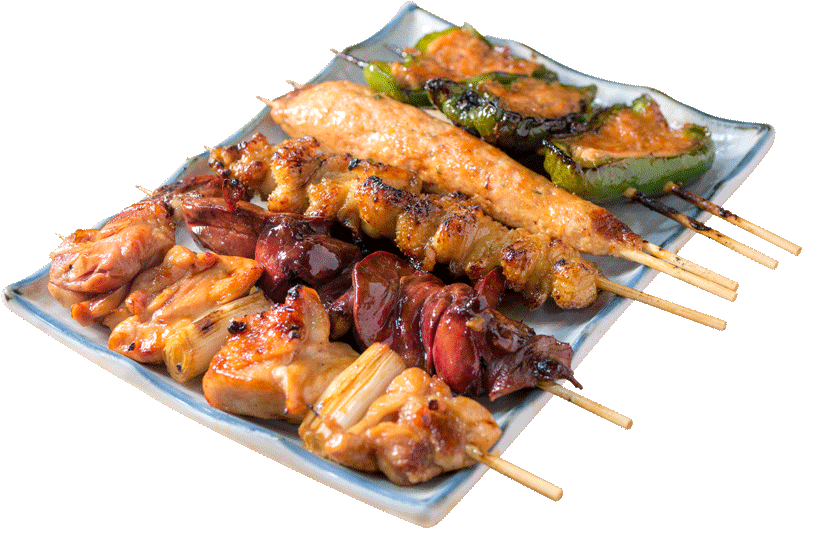
Shibuya has a thousand places to eat and most of them want your attention. This one has been quietly filling three floors since 1963. Eat here once and you can skip every other yakitori shop in Tokyo — and that is not really a claim about the chicken.
The call
Toritake, on Dogenzaka, right beside Shibuya Mark City. Charcoal yakitori, open from noon, every day of the year. In this writer’s Tokyo top three for yakitori — and the other two are not places you can walk into at 1pm without a reservation.
Go here once and you do not need to go to another yakitori shop. Not because there are no better skewers somewhere in this city; there are always better skewers somewhere in this city. Because everything a Japanese drinking house is happens to be present in this one building, at the same time, on a Tuesday afternoon.
Order skewers, one of the vegetable ones, and a large bottle of lager. Budget ¥2,000–3,000 a head. If you have put a bag in a Mark City locker and have two hours, this is the answer to what you do with them.
The tier of restaurant nobody explains to you
English-language guides give you two kinds of yakitori. The izakaya chain, where it is cheap and fine. Or the counter with eight seats where a chef serves you fifteen courses of chicken for ¥20,000 and you should probably book two months out.
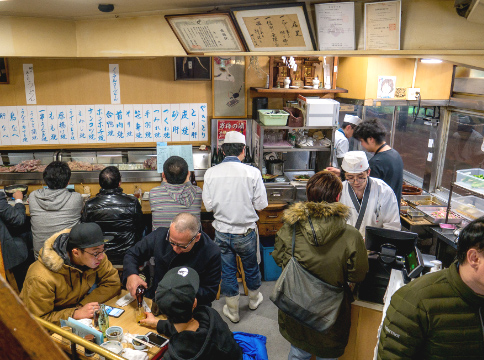
There is a third tier, and it is where Japanese people actually eat. The taishu yakitori shop — the popular one, the neighbourhood institution. Decades old, three floors, loud, no dress code, no ceremony, and the grilling is as good as the expensive place because the person doing it has been doing it for thirty years.
Toritake is the Shibuya example. It is not a hidden gem — it is on Tabelog’s Top 100 Yakitori list and has over 2,000 reviews. It is simply invisible to visitors, because it looks like an old building on a busy hill and nobody has told you to go in.
The skewers
The house thing is the ōgushi — the big skewer. Not a marketing word. Here is what it actually means:
Toritake grills its chicken on eel skewers. Eel skewers are longer and heavier than yakitori skewers, because eel is heavier than chicken. So the portions are sized to the skewer, and the skewer was built for something else. That is why the food arrives looking faintly absurd.
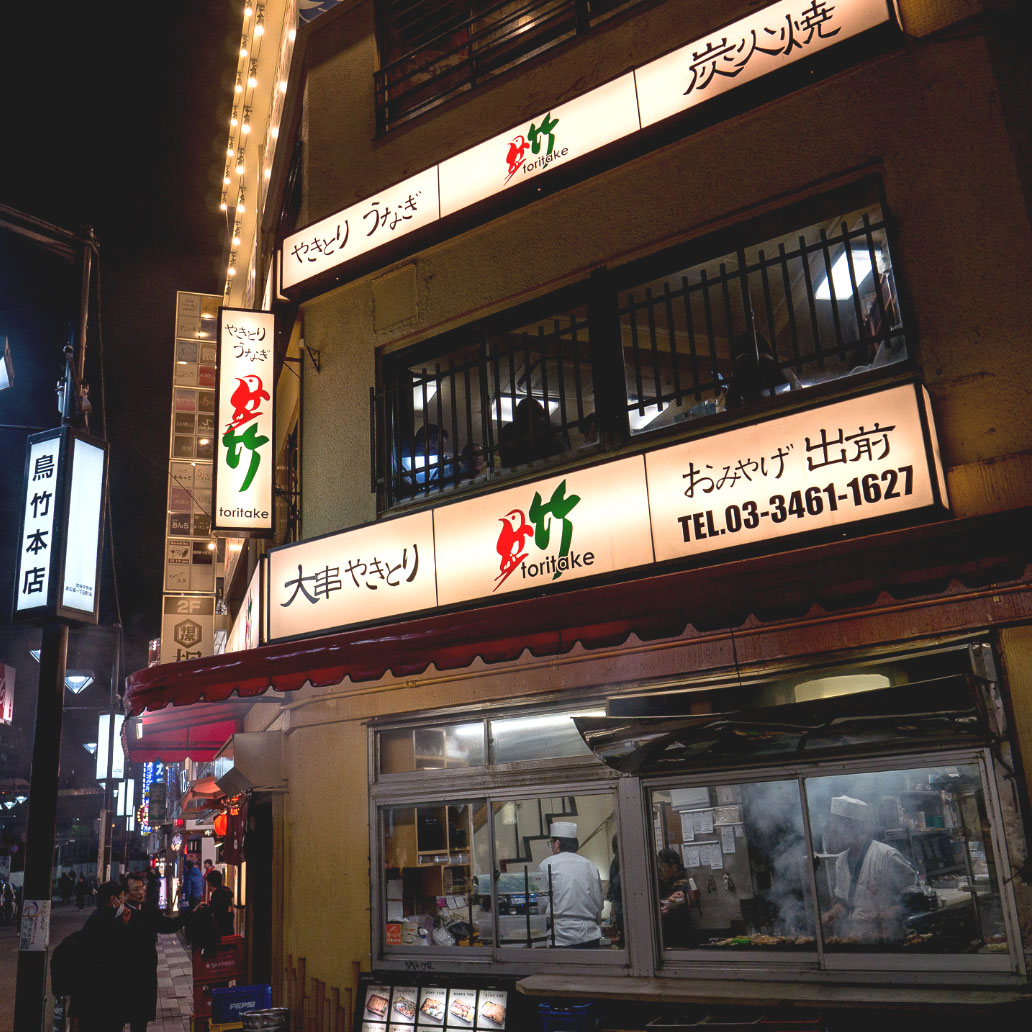
They can do that because they are also an eel restaurant, which is the next thing.
The tare — the sweet soy glaze — has been topped up rather than replaced since 1963. Sixty-three years of the same pot. You can have salt instead, and for the plain chicken you should try one of each.
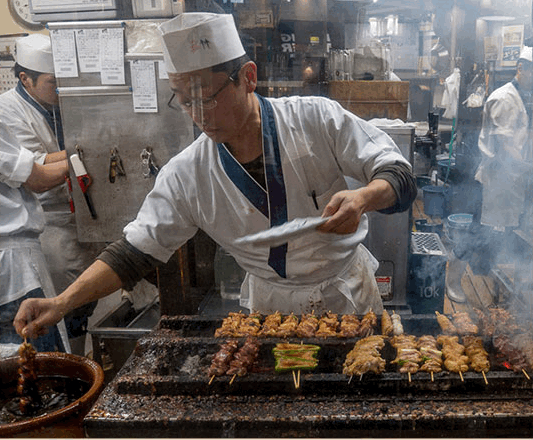
Then get a vegetable skewer. Grilled vegetables at a yakitori shop are usually an afterthought; here they are chosen for size and texture and they come off the charcoal properly. Ask for whatever is on the counter.
They butcher eel in the building
Toritake is a yakitori shop and an unagi shop. Whole chickens and live eel, broken down in-house, skewered by hand, grilled over charcoal.
This matters for two reasons. One, the eel is priced jika — market rate, ask on the day — which is normal for eel in Japan and alarming if you have not seen it before. Two, eel in Tokyo is usually a formal, expensive, slightly intimidating meal in a quiet room. Here you can eat properly grilled kabayaki in a noisy three-floor drinking house at two in the afternoon. There is nowhere else in Shibuya doing that.
The part that does not add up
Dogenzaka is one of the most expensive slopes of ground in Tokyo. Toritake holds 128 seats across three floors of it, from basement to second floor, and sells skewers for around ¥333–383 each.
It opens at noon and closes at 23:00, 365 days a year apart from four days at New Year. No closing day. Most Tokyo yakitori shops open at five in the afternoon and shut on Sundays; this one is grilling while you are still deciding what to do with your morning.
Sixty-three years in the same spot, in the neighbourhood that demolishes and rebuilds itself faster than anywhere in Japan. Shibuya station has been under construction for most of the last fifteen years. Toritake has not moved.
The drinks, which are not an afterthought
Order the large bottle of Sapporo Lager — the one Japanese drinkers call Akaboshi, “red star”, after the label. It is not the beer they advertise, it is the beer old drinking places keep, and asking for it by name is a small tell that you know where you are.
There is also a house dai-nama — a draft in a genuinely silly-sized mug — plus shochu, sours, and a proper sake list. This is a drinking house that happens to grill extremely well, and the drink list is built accordingly.
The dishes to order that are not skewers
- Nikomi — slow-simmered offal in broth. The permanent bestseller. Order it even if that sentence did not sell it to you
- Nikogori — the shop’s chicken stock, set into a savoury jelly and served cold. A yakitori shop’s party trick, and almost never on menus abroad
- Hiyashi tomato — a chilled tomato, cut into wedges. Yes, that is the whole dish. It is on every good drinking-house menu in Japan and it is genuinely what you want next to charcoal and salt
- Yakitori-don — skewered chicken over rice with the sixty-three-year tare poured on. The lunch order, and the one to get if you only have thirty minutes
Ordering it without Japanese
Easier than the building suggests. Reservations are only taken for parties of five or more, which means that as a couple or a pair you simply walk in — no booking, no app, no problem. It also means you may wait at peak times. Come at 12:00, or after 20:30.
The staff are used to a Shibuya crowd and are, unusually for a shop this old, actively friendly. Point at the counter, hold up fingers, say tare or shio. Nobody minds.
Two things worth knowing: they take cards as well as cash, which is not a given in this category of shop. And the entrance is at street level — if you come up from the underground passages, use exit 2 or 5, otherwise you will surface on the wrong side of the crossing and lose ten minutes to the world’s most photographed traffic light.
Practical
| What to order | ōgushi skewers (tare or salt), a vegetable skewer, nikomi, large Sapporo Lager. Eel at market price. Around ¥2,000–3,000 a head; the shop’s own takeaway list runs ¥333–383 a skewer |
|---|---|
| Hours | 12:00–23:00, last orders 22:00. No closing day — only 31 December to 4 January |
| Where | 1-6-1 Dogenzaka. Immediately right of the Keio Inokashira Line west exit, next to Shibuya Mark City. Three minutes from the JR Hachiko exit, four from the Metro lines |
| Seats | 128, basement to 2F. Entirely non-smoking |
| Reservations | Five or more only, by phone, arriving before 19:00, two-hour limit. Fewer than five: walk in |
| Payment | Cash and credit cards |
| Official site | toritake.jp — Japanese only, but it has photographs of the skewers and the current menu, and the phone number for large bookings is 03-3461-1627 |
| Also | Takeaway skewers and bento, if your plan is a bench and a beer instead |
Skip it if…
- …you want quiet. Three floors of people enjoying themselves is the atmosphere, not a flaw in it
- …you want the fifteen-course chef’s-counter yakitori experience. Different tier, different evening, book ahead
- …you do not eat chicken. There is eel and there are vegetables, but this is a chicken shop
- …you are six people arriving at 20:00 with no booking. That is the one combination that will not work
Everything a sakaba is, in one building
A sakaba is not a restaurant. Nobody curates your evening, nothing is plated for a photograph, and the room is not designed to be pleasant — it is designed to be used. Tokyo has thousands of them and most visitors never sit down in one, because from the street they look closed, or private, or like somewhere you would need to be invited.
Here is what a proper one contains. Toritake has all of it at once:
- It is open when you are free. Noon to eleven, every day of the year. A drinking house that keeps office hours is not one
- Nobody minds that it is two in the afternoon. Daytime drinking carries no apology in a place like this. There will be men in suits, men who finished a night shift, and someone eating alone with a newspaper
- The beer is the one drinkers ask for, not the one on television. A large bottle of Sapporo Lager, poured into a small glass, topped up as you go
- The food is salt, fat, charcoal and something cold and sharp. Skewers, then a chilled tomato. That is the rhythm and it has not needed improving
- Something has been going for decades without being replaced. Here, the tare: sixty-three years in the same pot
- It is loud, and the noise is other people. Not music. Three floors of conversation, which is the actual sound of this country relaxing
- You cannot book, and it does not matter. Under five people, you turn up. The room absorbs you
Most places give you two or three of these. Restaurants aiming at visitors give you none of them, and give you an English menu and a photograph opportunity instead. Toritake gives you the whole set and an English menu is beside the point — though the staff will get you through it happily.
That is why one visit is enough to stop looking. You have not eaten the best skewer in Tokyo. You have been inside the thing itself.
The local test
Two things a Japanese drinker would notice about Toritake and a visitor would not.
It has been on Yoshida Rui no Sakaba Hōrōki — a television programme that has been visiting ordinary Japanese drinking houses weekly for over twenty years, and which functions as the closest thing this country has to a canon of proper places to drink. Being in it is not a tourist badge. It is the opposite of one.
And the second floor appears in World Order’s Shibuya video — the Japanese dance group whose whole visual language is deadpan salarymen moving through real Tokyo. When they needed a room that says this is Shibuya, they filmed here.
Founded 1963, on Tabelog’s Top 100 Yakitori list, 2,000-plus reviews, still full on a wet Tuesday. That is not nostalgia keeping a shop open.
The bottom line
Shibuya is the neighbourhood visitors are most likely to walk through and least likely to eat well in. Toritake fixes that for about ¥2,500, from noon, without a reservation, next door to the lockers.
And it settles a larger question. People arrive in Tokyo with a list of things to eat and no idea where the drinking happens. It happens in rooms like this one, and this one is forty seconds from a locker. Go in.
Read nextWhere to leave your bags in Shibuya →Every locker bank, the two staffed counters, and the Mark City answer — forty seconds from Toritake’s door.
Prices, hours and details as of September 2026; the shop revised its prices in August 2025 and eel is always market rate. Photographs courtesy of Toritake. Corrections via the contact page.
Leave a Reply