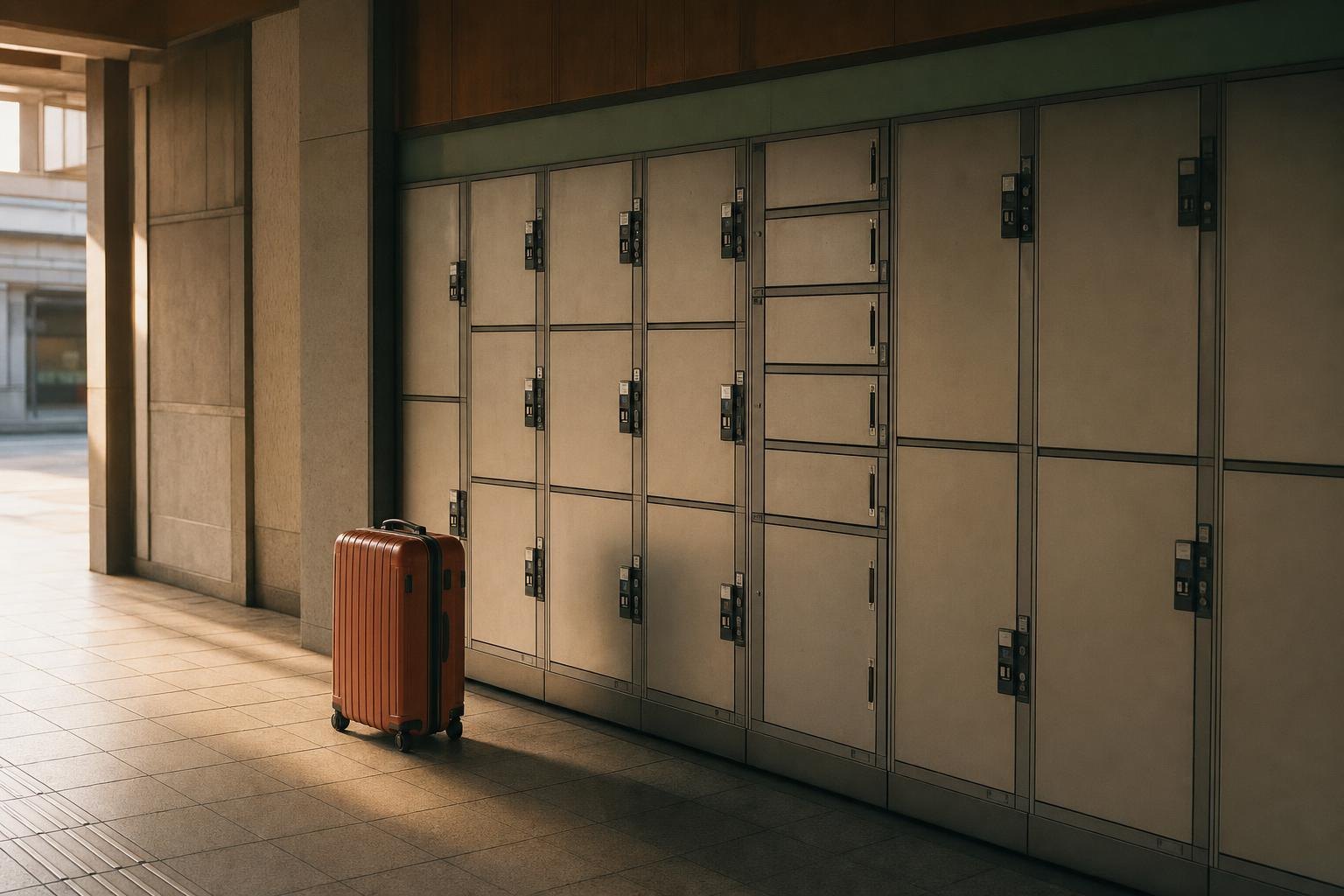
Checkout is 10am, your flight is at 9pm, and you have a large suitcase and eleven hours. Here’s the whole decision, in order of what to try first.
The call
Ask your hotel first. It’s free, it’s standard practice in Japan, and it works both before check-in and after checkout. Most travellers skip straight to hunting for a locker and pay ¥800 they didn’t need to spend.
If you have no hotel that day: book a storage slot online (¥500–800 per bag) rather than trusting you’ll find an empty locker. Big lockers in central Tokyo on a weekend are a genuine lottery.
If the bag needs to be somewhere else — your next city, the airport, tomorrow’s hotel — that’s not storage, that’s luggage forwarding, and it’s a different (better) answer.
Option 1: your hotel (free)
Japanese hotels and ryokan will hold your bags on the day you check in and the day you check out, as a matter of course, at no charge. You don’t need to negotiate it — the phrase is “nimotsu wo azukete kudasai,” but “can you hold my bag?” works fine at any hotel with foreign guests.
Limits worth knowing: it normally covers that day, not several days. Larger chain hotels will often hold bags for longer on request; a small ryokan may not. And this only applies if you’re a guest — hotels don’t store bags for the general public, so if you checked out yesterday, this option is closed.
Option 2: coin lockers (¥300–1,000/day)
Still the cheapest paid option, and Tokyo has an enormous number of them — roughly 3,600 at Shinjuku, over 1,500 at Tokyo Station.
| Size | Fits | Price/day |
|---|---|---|
| Small (~35×31×64cm) | Backpack, tote | ¥300–500 |
| Medium (~35×54×64cm) | Cabin bag | ¥400–700 |
| Large (~35×83×64cm) | Large suitcase | ¥600–1,000 |
Most central Tokyo lockers now take Suica or PASMO, and newer machines accept QR payments. Some older ones are still ¥100 coins only, so keep a few.
The catch: large lockers fill up. On a weekend morning at Tokyo, Shinjuku, Shibuya or Ueno, and during Golden Week, Obon or peak blossom season, assume the big ones are gone by mid-morning. Before you drag a suitcase around a station guessing, use a vacancy checker — Locker Concierge and Coin Locker Navi show real-time availability, and several stations have Suica locker-search kiosks with colour-coded maps.
The other catch: the limit is three calendar days, not 72 hours. After that staff empty the locker and your things go to a storage facility, which is a bad afternoon to have.
Option 3: booked storage (¥500–800/bag/day)
You book online, drop your bag at a partner shop, café or hotel, and collect it later. The advantage over a locker is certainty: you reserved a space, so it exists, and the price is flat regardless of how absurd your suitcase is.
- ecbo cloak: ¥500/day for bags under 45cm, ¥800/day for suitcases. 2,500-plus locations nationwide. Since late 2025 this includes several hundred 7-Eleven stores — a meaningful upgrade, because convenience stores are everywhere and some are open around the clock.
- Radical Storage: flat rate from around ¥600/day per bag in most of Tokyo, any size, with insurance included. Good coverage across the tourist wards.
The one thing to check: your bag lives inside someone else’s business, so you’re bound by that shop’s opening hours. Book a café that closes at 6pm and you have a 6pm problem. Read the hours before you book, not after.
Reserve a spot
Flat rate per bag per day, any size, insured. Booking ahead beats hunting for an empty locker on a Saturday.
Option 4: staffed counters
For genuinely oversized things — skis, a bike box, the suitcase that defeats large lockers — use a counter.
- Tokyo Station, JR East Travel Service Center: around ¥500 (small) to ¥2,000 (over 200cm total dimensions), roughly 8:30am–7pm. Same-day only — this is not overnight storage.
- Sagawa Express service centre near Tokyo Station: flat ¥800/day, open 7am–11pm. Better hours than the JR counter, and worth knowing about.
- Haneda Airport: ¥300 (under 120cm) to ¥900 (200–300cm) per item per day, up to two weeks.
- Narita Airport: from roughly ¥520/day at manned counters, up to eight days.
Station by station: where the lockers actually are
The general advice above is fine until you’re standing in Tokyo Station with a 28-inch case and no idea which of 26 locker banks to try. So here’s the specific version.
Station-by-station deep dives: Tokyo Station · Shinjuku · Shibuya · Asakusa & Ueno. The summaries below are the short version of each.
Tokyo Station
Roughly 5,000 lockers spread across about 26 locations — and still the hardest station in the city to find an empty large one. The reason is geography: the Marunouchi side (Imperial Palace, tourists) has relatively few lockers and mostly small ones, while the Yaesu side (Shinkansen, buses) holds most of the capacity. If Marunouchi is full, walk through to Yaesu before giving up. A new locker hub under the Yaesu bus terminal reportedly added a few hundred units in 2026, including XL sizes.
Staffed options if the lockers defeat you: the JR East Travel Service Center at the Marunouchi North Exit (8:30–19:00, roughly ¥500–2,000 by size, same-day only), GRANSTA Cloak inside the Yaesu underground central gate (open until 21:00), and the Sagawa Express service centre in First Avenue near the Nihonbashi Exit (7:00–21:00). Suica locker-search kiosks in the station show which banks have space — use them before walking.
Shinjuku Station
The largest locker inventory in Tokyo, which is why it’s the one station where wandering usually works. The biggest single cluster is underground at the West Exit (B2, via the JR West Exit gates). Large suitcase-size lockers are concentrated around the East Exit near Studio Alta. Two more clusters sit by the New South Gate on the 2nd floor, right by Busta Shinjuku — convenient if you’re catching a highway bus to Fuji or Nikko.
Inside Busta itself (4F) the lockers are time-based rather than daily, and the price climbs quickly — fine for a two-hour wait, poor value for a full day. No dedicated staffed baggage counter that we could confirm, so if you need one, Tokyo Station or a booked-storage shop is the answer.
Shibuya Station
Close to a thousand lockers across the JR, Metro and Keio stations, and yet the ones by the Hachiko Exit are full from mid-morning on any weekend. Two reliable fall-backs: the locker bank on the 1st floor of Shibuya Scramble Square (in front of the elevators) and B3 of Hikarie, next to the restrooms. Shibuya also has among the densest booked-storage coverage in the city — cafés and shops that take bags via app — so on a Saturday it’s often faster to reserve than to hunt.
Ueno Station
Around 300 lockers. The Shinobazu Exit has lockers just inside the gate and more in the connecting passage; the Park Exit has a bank right after the gates facing the park. Cited prices here run ¥500 small / ¥800 large. The practical reason people need Ueno storage: the museums. The Tokyo National Museum has free lockers but they’re small and often full — leave the suitcase at the station, take a daypack into the park. Shinobazu Exit is also the one that faces Ameyoko market.
Asakusa
Locker-poor for how many visitors it gets. The largest bank is on the 2nd floor of Tobu Asakusa Station; Toei Asakusa has touch-screen lockers by both gates at ¥300/500/700. Expect them to be full by late morning in high season. Staffed alternatives: the Yamato counter on the 1st floor of Ekimise (the Tobu station building, 10:00–19:00, about ¥500 a bag) and the Sagawa service centre near Kaminarimon (9:00–19:00, ¥800 a bag). Asakusa is also one of the best-covered areas for booked storage, which for a temple-and-lunch afternoon is the least stressful option.
Narita and Haneda
Haneda is straightforward: temporary baggage storage counters in every terminal (T1 and T2 at B1, 8:00–19:30; T3 counters run 24 hours), priced ¥800 small / ¥1,000 medium / ¥2,000 large per day, up to two weeks, max 30kg. Narita has JAL ABC and Sagawa counters in T1 and T2 (1F before security, roughly 6:30 until the last arrival) — note there’s no staffed storage in Terminal 3, so budget LCC passengers should walk to T2. Prices vary by operator and size; expect ¥500–1,100 a day.
German readers: yes, these are the Schließfächer — same system, and the vacancy tools below work in any language.
Finding an empty locker before you walk
- LuggageSnap — real-time coin-locker availability by station, in English, updated every few minutes. Has a Tokyo Station page
- Suica locker-search kiosks — touch screens at Tokyo, Shinjuku, Ikebukuro and Shinagawa showing colour-coded availability maps. Only useful once you’re there
- ecbo cloak app — not lockers, but real-time availability at partner shops and 7-Elevens, bookable in English. Since late 2025 that includes several hundred 7-Eleven stores, some open around the clock
Skip the locker hunt
At Tokyo Station, Shibuya or Asakusa on a weekend, a reserved spot beats twenty minutes of walking between full locker banks. Flat rate per bag, any size, insured.
Storage or forwarding? The dividing line
Simple rule: if the bag needs to end up where you started, store it. If it needs to end up where you’re going, ship it.
Takkyubin courier forwarding runs roughly ¥1,600–3,700 depending on size, and typically arrives next day (same-day only for short local routes if you drop off in the morning). It’s more per bag than a locker — and completely worth it when the alternative is hauling two suitcases through Shinjuku Station at rush hour to reach a Shinkansen.
One thing worth knowing before you assume forwarding is a faff: you can hand a suitcase over the counter at a 7-Eleven or FamilyMart, at any hour, including sending it to Narita or Haneda. It is not a hotel-front-desk-only service, and that changes when it is useful. How to do it without Japanese.
Full breakdown in our guide to sending luggage ahead in Japan.
What actually goes wrong
- “All the big lockers were full.” The single most common complaint, and entirely predictable at weekends. Check vacancy online, or book storage instead.
- “I couldn’t find the lockers.” Shinjuku’s are scattered across multiple exits and levels. Note which exit you used, or take a photo of the locker bank and its number. People do lose lockers.
- “My suitcase didn’t fit the large locker.” Oversized hard cases sometimes don’t. Counters and booked storage have no such problem.
- “I left it for four days.” Three-day limit. Use booked storage for anything longer.
FAQ
Can I leave a bag overnight?
Coin lockers: yes, up to three days, paying per day on retrieval. Booked storage: yes. JR staffed counters: no — same-day only.
Is it safe?
Yes, remarkably. Japan’s low-theft reality extends to left luggage, and booked services add insurance on top. Passports and valuables still ride with you.
Do I need cash?
Less and less. Most central Tokyo lockers take IC cards, and booked storage is prepaid online. Carry a few ¥100 coins anyway for older machines.
What about the airport on my last day?
If you’re flying out, don’t store — check in early. Most airlines accept bags several hours before departure, and once your suitcase is on the belt you’re free until boarding, for nothing.
The bottom line
Hotel first, because it’s free. Booked storage second, because it’s certain. Coin locker third, because it’s cheapest when it works. Courier when the bag is going somewhere you aren’t.
And a small piece of advice that saves more hassle than any of the above: on the day you leave Tokyo, decide where the suitcase sleeps before you check out — not while standing outside the hotel with it.
Prices as of August 2026 and subject to change. Corrections via the contact page. Some links here are paid affiliate links.
Leave a Reply