Standing soba is the most-eaten restaurant food in Tokyo and the least-written-about. Nobody flies here for it. That is exactly why it is worth ten minutes of your trip.
The call
Kameya, in Omoide Yokocho, two minutes from Shinjuku West Exit. The writer of this site has eaten at a great many standing soba counters in Tokyo. This is the best bowl of the lot — not the most famous, not the cheapest, the best.
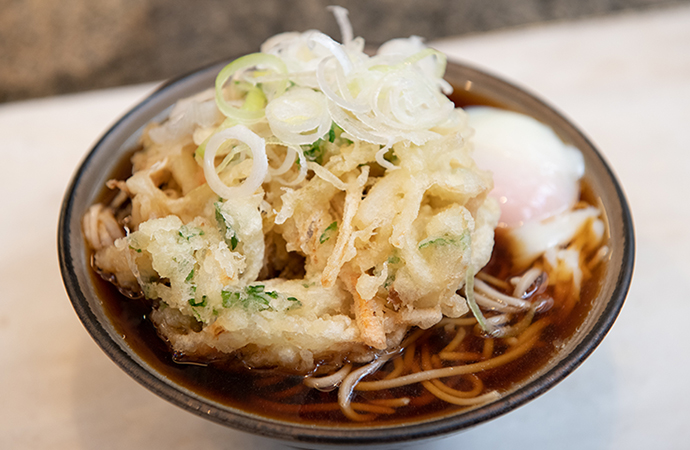
Order the ganso tenmatama soba, ¥570. Eat it standing. Leave in ten minutes. It will be one of the cheapest things you do in Japan and one of the ones you describe when you get home.
What standing soba actually is
A word on the category, because English guides skip it entirely.
Tachigui soba — standing soba — is commuter infrastructure. There are counters in and beside almost every station in Tokyo. You go in, you eat a bowl of buckwheat noodles in hot broth in under ten minutes, standing up, and you carry on to work. It costs the price of a coffee. Millions of people do this several times a week and think nothing of it.
It is not street food and it is not a tourist experience. It is the closest thing Tokyo has to a canteen, and the good ones are very good indeed — which is where Kameya comes in.
The shop
Kameya opened in 1971 in Omoide Yokocho, the lane of tiny post-war eating houses wedged under the tracks by Shinjuku’s west side. Fifty-five years later the Shinjuku shop is still the original of what is now a small group with branches in Kanda and Shimbashi.
Eight places at a counter. No chairs. No reservations. Cash only.
The bowl
The house dish, unchanged for over fifty years, is the ganso tenmatama soba: buckwheat noodles, a kakiage fritter of onion, shungiku and carrot fried to order, and a soft onsen egg. It arrives with shredded raw spring onion and a dab of wasabi, in a black bowl, and the fritter is wider than the bowl’s rim.
Break the egg into the broth before you start. The yolk thickens it; that is the whole design of the dish. Then eat the kakiage fast, while the outside is still crisp and the underside has begun to go soft in the soup — the two textures at once are the point, and they do not last.
There is a cold version too, which is what you want in a Tokyo August.
The part that does not add up
Here is why this bowl is worth writing about rather than just eating.
- The noodles are made in their own factory every morning — that day’s quantity only — from a blend of buckwheat and wheat flour specified for this shop
- The broth uses hon-karebushi bonito, the slow-cured grade, and kombu from Hakodate
- The kaeshi, the soy-and-sugar base that gives the broth its backbone, is aged at least 45 days
- None of the three contains MSG
That is the specification sheet of a restaurant. It is being executed at a standing counter, for ¥570, for people who eat it in nine minutes on the way to an office.
The gap between those two facts is the most Japanese thing on this website.
Ordering it without Japanese
Easier than it looks. There are English, Chinese and Korean menus — a 1971 standing soba counter in an alley under the railway has translated its menu, which tells you something about who has been turning up.
Say tenmatama soba, or point. Pay cash. Stand at the counter. Nobody expects conversation and nobody will mind how you eat.
Two small things that make you look like you have done this before: do not linger after the bowl is empty — eight places and a queue — and put your rucksack between your feet rather than on the counter.
Practical
| What to order | Ganso tenmatama soba ¥570. Tempura soba ¥500, tororo kombu soba ¥450, cold versions around ¥550. Nothing on the menu passes ¥1,000 |
|---|---|
| Hours | 06:00–23:00, closed Sundays |
| A warning about the hours | It ran 24 hours for years, and older listings and signs still say so. That was suspended in June 2026. Do not plan a 3am bowl |
| Where | 1-2-10 Nishi-Shinjuku, in Omoide Yokocho. Two minutes from the JR Shinjuku West Exit, four from Seibu-Shinjuku |
| Seats | Eight, counter only, standing. No reservations. Non-smoking |
| Payment | Cash only. No cards, no IC, no QR |
| Also | Handmade onigiri, takeaway, and bottled Coca-Cola, which is a small joy of its own |
Skip it if…
- …you want to sit down. There are no chairs, and that is not an oversight
- …you are a group of four or more. Eight places means one or two people
- …you have a suitcase with you. The counter has no room for it — and the West Exit lockers are two minutes away, which is the entire reason we mentioned this shop in the Shinjuku luggage guide
- …it is Sunday
The local test
Would people here actually choose this? It is second in Shinjuku’s soba ranking on Tabelog across more than 1,700 reviews, and nearly 36,000 people have saved it — from a shop with eight standing places. That is not a tourist number. That is commuters voting with their feet, every morning, for fifty-five years.
Go at 7am before the crowds, or at 10pm on your way back to the hotel. Both are correct.
Prices, hours and details as of September 2026 — the 24-hour opening in particular is currently suspended, so check before a late-night visit. Corrections via the contact page.
Leave a Reply