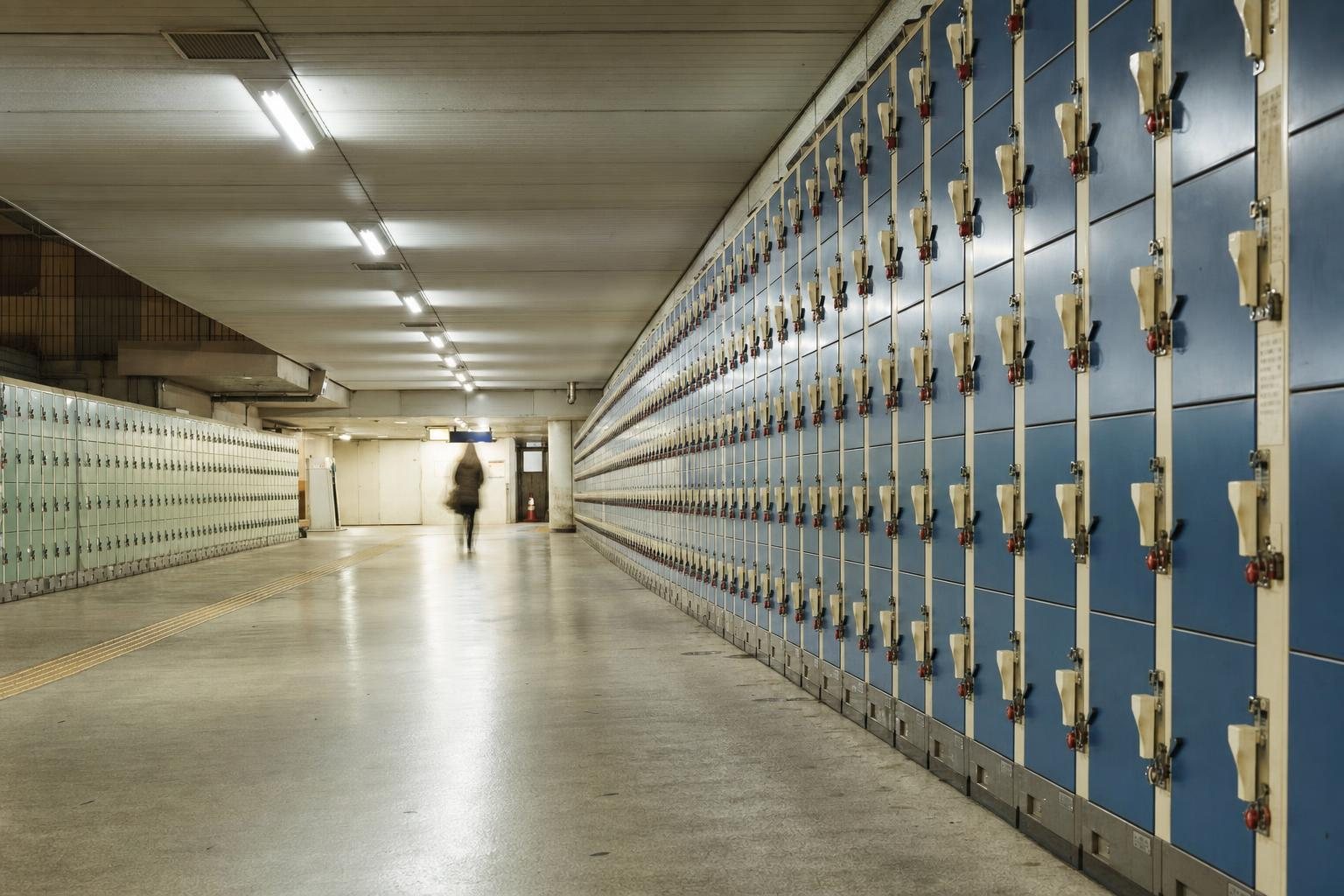
Shinjuku has more lockers than any station in the world — somewhere around 3,600 — and finding one is still mostly luck if you don’t know which staircase to take.
The call
Need a large locker? Go underground on the West Exit side. That corridor is the biggest single cluster in the station and the reason Shinjuku is, despite the chaos, an easier station to store a bag than Shibuya or Asakusa.
Catching a highway bus to Fuji, Hakone or Nikko? Use the New South Exit banks on the 2nd floor, next to Busta. Do not leave a bag in Busta’s own lockers for a whole day — see below.
Reserve, rather than gamble
Shinjuku has the most lockers in Tokyo and they still run out at the convenient exits. A booked spot removes the search. Flat rate per bag per day, any size, insured.
Everything full? There are four staffed counters here, which is unusual and genuinely useful.
Where the lockers are
- West Exit, underground (B1–B2) — the big one. From the JR West Exit gates head toward the Odakyu department store basement escalators and into the long corridor. Hundreds of lockers in all sizes
- East Exit, street level (near the old Hato Bus office, close to Studio Alta) — around 15 SS / 77 S / 47 M / 64 L. The best concentration of large lockers on this side. Note the East Exit layout has been reshuffled through 2025–26 as construction moves things around
- East Exit, B1 underground passage — a handful of small banks just outside the Central-East and East gates
- South Exit, 2F inside the gates — 80 S / 85 M / 76 L, near the JR–Odakyu transfer gate
- New South Exit, 2F outside the gate — two banks, one by the Suica Penguin Square (15 S / 13 M / 41 L), one by the platform 13/14 escalators
- B1 corridor toward platforms 5–6 (the Narita Express platforms) — JR East’s own guide calls this an anaba, a spot likely to still be free, because it’s off the main walking route. Inside the gates
- Keio Line and Inokashira Line — ten separate locker locations on B1, with their own live availability map at keiochika.co.jp
- Odakyu South Gate, 2F — two banks. Note Odakyu’s West Gate has none
Kabukicho has no locker bank of its own. If you’re heading out for the evening there, the East Exit banks are your storage.
While you are here: the best standing soba in Shinjuku
An aside, because the bag is in a locker and you have an hour.
Two minutes from the West Exit lockers is Omoide Yokocho — “memory alley” — a lane of tiny post-war eating houses wedged under the railway. Most visitors photograph the lanterns and walk on. Go into Kameya instead.
Order the ganso tenmatama soba, ¥570. Buckwheat noodles in hot broth, a kakiage fritter of onion, shungiku and carrot fried to order, and a soft onsen egg on top. It has been the house dish for over fifty years.
Now the part that should not add up. The noodles are made in their own factory every morning, that day’s quantity only. The broth uses hon-karebushi bonito and kombu from Hakodate. The kaeshi — the soy base — is aged at least 45 days. None of the three contains any MSG. That is the specification of a restaurant, and it is being served at a standing counter for the price of a coffee, to people who eat it in nine minutes on their way to work.
The writer of this site has eaten at a great many standing soba counters in Tokyo. This is the best bowl of the lot. Not the most famous, not the cheapest — the best.
Practical
- ¥570 for the tenmatama. Plain tempura soba ¥500, tororo kombu ¥450. Nothing on the menu passes ¥1,000
- 06:00–23:00, closed Sundays. It used to run 24 hours and the sign may still say so — that was suspended in June 2026, so do not plan a 3am bowl
- Eight places, standing, no reservations. You order, you eat, you are out in ten minutes. Nobody expects conversation
- Cash only — no cards, no IC, no QR. In this category of shop that is a good sign rather than a bad one, and the correlation is real
- There are English, Chinese and Korean menus. A 1971 standing soba counter in an alley under the tracks has translated its menu, which tells you something about who has been coming
- Opened 1971. The Shinjuku shop is the original; there are now branches in Kanda and Shimbashi
Break the egg into the broth before you start. That is the entire point of the dish.
Read nextKameya, Shinjuku: the best standing soba in Tokyo, for ¥570 →Why the specification of a ¥570 bowl reads like a restaurant’s, how to order it without Japanese, and the hours that changed in June 2026.
Prices
JR’s Multiecube lockers: SS ¥300, S ¥500, M ¥700, L ¥900, plus a ¥100–200 surcharge on M and L in peak seasons. Older non-Multiecube banks: SS ¥300, S ¥500, M ¥800, L ¥1,000.
Modern units take coins and IC cards; old key-type ones are coin only. You can reserve a Multiecube locker up to a month ahead for ¥500 extra.
The Busta Shinjuku trap
Busta’s own lockers on the 4th floor look convenient, and for a two-hour wait they are. But they’re priced by time, not by day, and the meter resets every six hours:
| Size | First block | Then |
|---|---|---|
| Small | ¥100 / 60 min | ¥500 per 6 hours |
| Medium | ¥100 / 40 min | ¥600 per 6 hours |
| Large | ¥100 / 30 min | ¥900 per 6 hours |
Leave a large bag there for a day and you’re looking at roughly ¥3,700 for a full 24 hours (¥100 for the first half hour, then four six-hour blocks) against ¥900–1,000 in an ordinary station locker fifty metres away. Maximum stay is 72 hours, they’re card and e-money only, and you unlock with a QR code on a printed receipt — lose the receipt and you have a problem.
Use Busta’s lockers while you wait for a bus. Use the New South Exit banks for anything longer.
Four staffed counters
- Sagawa Cloak & Delivery — inside the Tokyo Tourist Information Center, Busta 3F (the bus gates are 4F; the counter is a floor below). 6:30–23:00, the longest hours of anything here. Around ¥800–1,500 by size. Also ships to your hotel, Haneda or Narita if you check in by 11:00
- Keio Nekonote — underground by the Keio New Line gates, under Lumine 1. 8:30–21:00, ¥1,000 per item, and can arrange courier shipping
- Odakyu Sightseeing Service Center — West and South Exit branches, by the Romancecar gates. Up to 160cm and 25kg, up to three days. West Exit check-in 8:00–16:00, South Exit until 18:30, pickup by about 19:00. If you’re going to Hakone this is also where luggage forwarding to your ryokan is arranged
- ecbo cloak at Keio Department Store 2F — ¥800 a day, but online prepayment only, no walk-ups, and store hours (10:00–19:00)
Guaranteed space, booked ahead
Booked storage removes the search entirely, and unlike the department-store counters it covers more of the day. Flat rate per bag, any size, insured.
Timing
No official occupancy data exists. The reported pattern is that large lockers at the obvious banks are mostly gone by 10am, while the awkward ones — the B1 corridor toward the Narita Express platforms, the deep West Exit stretch — hold out much longer. JR East effectively confirms this by labelling that corridor a likely-vacant spot in its own guide.
FAQ
How long can I leave a bag?
Station lockers bill per 24 hours with caps of roughly three to four days depending on the operator. Busta is a hard 72 hours. Odakyu’s counter takes three days. Sagawa’s counter is the one to ask about longer.
I’m catching an early highway bus.
Sagawa’s 6:30 opening at Busta 3F is the earliest staffed option in the station.
Is there anywhere near Shinjuku Gyoen?
Use the South or New South Exit banks — they’re the closest side of the station to the garden.
Can I leave a bag overnight and collect it after a night in Golden Gai?
Yes, but note that many station-area banks are behind shutters that close after the last train. Check the posted hours on the bank you use before you rely on a 2am pickup.
The bottom line
West Exit underground for capacity, East Exit street level or New South for large lockers, Busta’s own lockers only for a short wait, and Sagawa on Busta 3F when everything else is shut or too big. Of Tokyo’s big stations, this is the one where persistence actually pays off.
See also: the full Tokyo storage guide, Tokyo Station, and the Fuji day trip that starts at Busta.
Locker counts and prices from JR East’s own station guide (August 2025 data) and operator sites, current as of September 2026. Shinjuku’s East Exit area is under construction and banks move. Corrections via the contact page. Some links here are paid affiliate links.
Leave a Reply