The short answer: bring your cards, plan to pay 80% of your trip with them, and carry about ¥10,000 (~$67) a day in cash for everything else — topping up from 7-Eleven ATMs as you go.
“Is Japan still a cash country?” is the wrong question in 2026. Japan is now a card country with cash pockets — over half of consumer spending is cashless — and the trick is simply knowing where those pockets are, because they happen to include some of the best parts of your trip.
Where your card just works
Convenience stores, chain restaurants, department stores, hotels, city taxis, drugstores: tap and go, including Apple Pay and Google Pay. Trains take your Suica (we settled the IC card question here) — and that same Suica balance pays at konbini and vending machines too. In central Tokyo you could genuinely go days without touching a coin.
Cash is not a limitation here. It is an admission ticket
Most guides treat Japan’s remaining cash pockets as an inconvenience to be routed around. That is the wrong way to think about it, and it will cost you the better half of the trip.
There is a correlation that every resident knows and no guidebook states plainly: the better the ramen, the less likely the card reader. The same is true of yakitori. A counter with six stools, one man, forty years of the same sauce, and a ticket machine by the door that takes coins and nothing else — that is not a shop that has failed to modernise. That is a shop that has decided its energy goes somewhere else. The card reader is often the tell that a place is aimed at you rather than at the neighbourhood.
So the cash in your pocket is not a workaround. It is what gets you through those doors.
And then there is the part that only works with coins
Japan still runs on a layer of small analogue machines that no app has replaced, and the physical act is the whole appeal.
Gachapon. The capsule toy machines that fill an entire wall in Akihabara, and sit in threes outside supermarkets everywhere else. You put the coin in. You turn the handle with your hand, and it resists slightly. Something falls, heavily, into the tray. You open a plastic capsule to find out which of twelve tiny animals you got, and it is the wrong one.
None of that survives being a tap on a screen. The coin is not the payment method — it is the mechanism. That is why the machines have not gone cashless and why nobody wants them to.
UFO catchers. Same principle, more expensive lesson. The claw is loose on purpose. You knew that and you played anyway.
Then the rest of it: festival stalls where a man is grilling squid and does not want to discuss payment technology. Rural buses where you drop coins into a box beside the driver. The tiny standing bar under the railway arches. Old-format ticket machines. Coin lockers in stations that have not been upgraded.
Running out of cash on a Saturday in a market town is a self-inflicted wound, and the injury is not financial. It is that you walked past the good place because you could not pay in it.
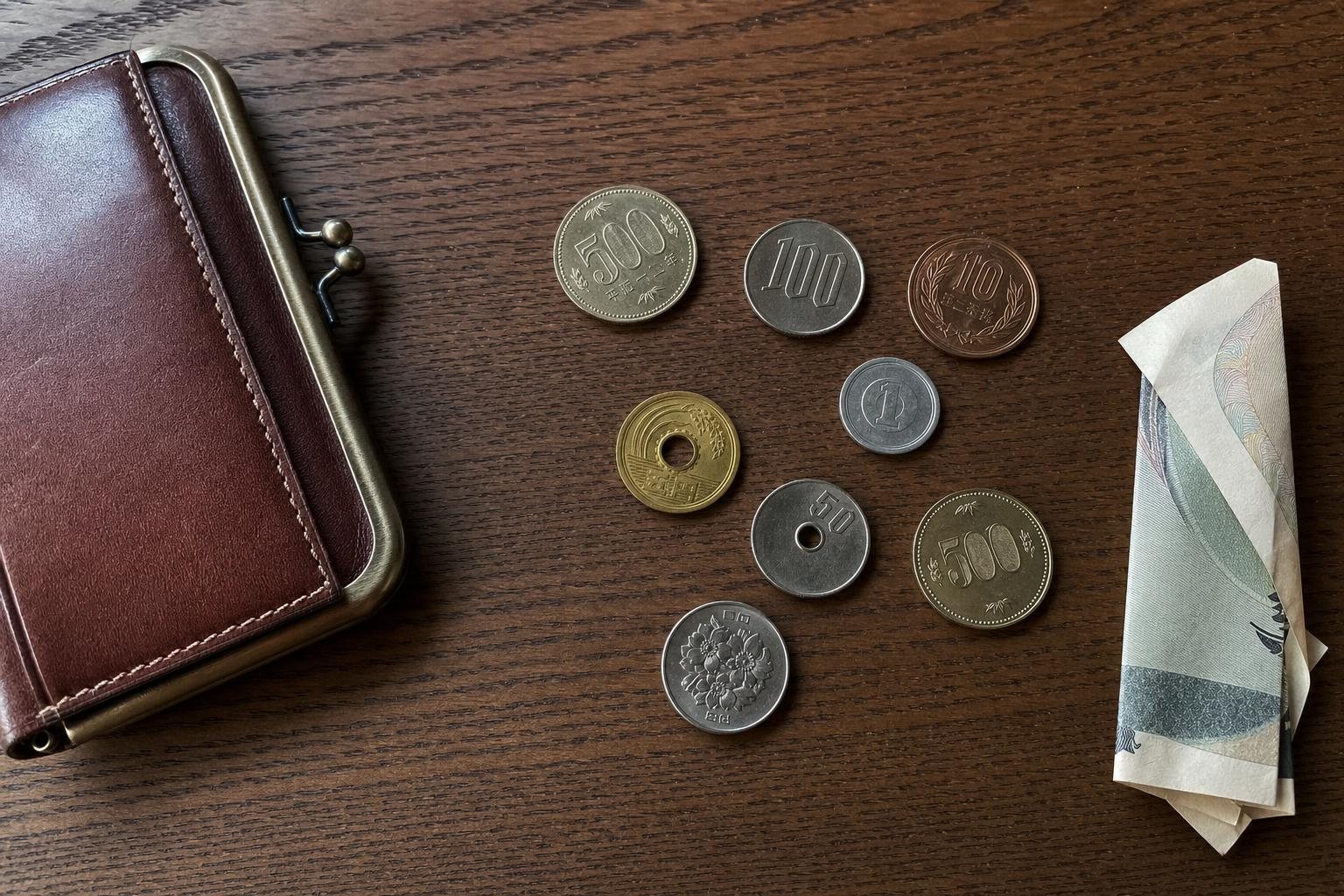
Practical version: keep ¥10,000 in notes and a genuine handful of ¥100 coins. Not for emergencies. For the machines.
Shrines and temples are more mixed than most guides admit. The large ones have quietly gone cashless in places: Shimogamo Jinja in Kyoto has taken cards and e-money at its amulet counter since 2019 — Visa, Mastercard, nanaco, Rakuten Edy, even PASMO — and Kanda Myojin in Tokyo accepts a phone payment for the offering box itself. Visitors arriving without coins were a large part of the reason.
But adoption is far slower here than in ordinary shops, and it is unpredictable: a famous shrine may take your card for an omamori while the small one on the hill behind it takes nothing. Carry coins anyway. Having a ¥500 coin in your pocket also means you can put something in the offering box without hunting for a terminal, which is rather the point of the gesture.
The ATM playbook (this is the important part)
Here is the fact that surprises people, and it is the reverse of what you would expect: in Japan, the bank will not give you money and the convenience store will.
Walk into a branch of one of the big Japanese banks — MUFG, SMBC, Mizuho — put a foreign card into the machine, and it will most likely decline it. Those ATMs are built for domestic cards. Meanwhile the cash machine tucked between the magazines and the hot food counter at 7-Eleven accepts practically every card on earth, in twelve languages, at four in the morning.
So: do not look for a bank. Look for a convenience store. There is one closer than the bank anyway.
| Where | Cards accepted | Their fee | Per withdrawal |
|---|---|---|---|
| 7-Eleven (Seven Bank) Your default |
Visa, Mastercard, Maestro, Cirrus, PLUS, Amex, JCB, UnionPay and most international debit networks | Mastercard, Maestro, Cirrus: none. Visa: ¥110 under ¥10,000, ¥220 above. Amex: ¥220 | Up to ¥100,000 with a chip card; ¥30,000 if your card is magnetic stripe only |
| Lawson (Lawson Bank) | Visa, Mastercard, Maestro, Cirrus, PLUS, UnionPay | Flat ¥75 — the cheapest counter fee in the country | Around ¥50,000 |
| Japan Post Bank | Major networks | ¥220 on some foreign cards | Around ¥50,000 |
| Japanese bank branches | Often none | — | Do not rely on these |
Two practical notes. If your card is a Mastercard, 7-Eleven charges you nothing at all, which makes the decision easy. And if you are carrying a card with no chip — still common on some older US accounts — your ceiling drops to ¥30,000 a go, so plan more trips.
The fee that actually costs you money is not the Japanese one. It is your own bank’s overseas withdrawal charge, which is frequently a percentage rather than a flat amount. Check it before you fly, and then withdraw in large chunks rather than small ones — ¥50,000 at a time rather than ¥10,000 five times. Seven Bank’s ATMs are open 24 hours, so there is no reason to run to empty.
Skip the airport currency counters beyond a few thousand yen of survival money, and do not bring a brick of cash from home to exchange. The rate at a convenience store ATM is the interbank rate your card issuer uses; the rate at a bureau de change is not.
So how much cash, actually?
- Baseline: ¥10,000 per person per day covers ramen lunches, shrine visits, snacks, a market splurge, and the odd cash-only izakaya — most days you’ll spend less and roll it over
- Budget travelers paying big items by card get away with ¥5,000–8,000/day
- Keep a ¥10,000–20,000 reserve note folded somewhere separate — for the rural day, the festival night, or the taxi where the card reader is “broken” (it happens)
- Coins matter: Japan will bury you in them. Feed ¥100s to lockers and vending machines, and dump the rest on your Suica or a konbini payment before flying home
FAQ
Should I exchange money before arriving?
Only pocket money for the first hours. The 7-Eleven ATM at your arrival airport gives a better effective rate than nearly any exchange counter.
Is tipping a thing?
No. Not taxis, not restaurants, not hotels. Excellent service is included; leaving coins mostly causes someone to chase you down the street to return them.
Card got declined at a small shop?
Not personal — minimum amounts and cash-only policies survive at small businesses. That’s what your ¥10,000 is for.
Can I rely on just my phone?
In Tokyo, mostly yes. Nationwide, no. Phone + physical card + daily cash is the redundancy that never fails.
What about traveler’s checks?
It’s 2026. No.
The bottom line
Cards for the predictable, cash for the memorable. ¥10,000 a day in your pocket, ¥50,000+ per ATM visit, always in yen, never tipping — that’s the entire system. The goal isn’t to avoid cash; it’s to never let a ticket machine stand between you and the best bowl of your trip.
Related: how tax-free shopping changes on 1 November 2026 (you’ll pay full price at the till and be refunded later, which affects how much card headroom you need), and what’s worth buying at a drugstore.
Cashless share based on METI’s 2026 release (58% of consumer payments in 2025, under the revised domestic metric). ATM specs from Seven Bank / Japan Post official pages, August 2026. Corrections via the contact page.
Leave a Reply